MiniMax Sparse Attention
Published in arxiv, 2026
Abstract
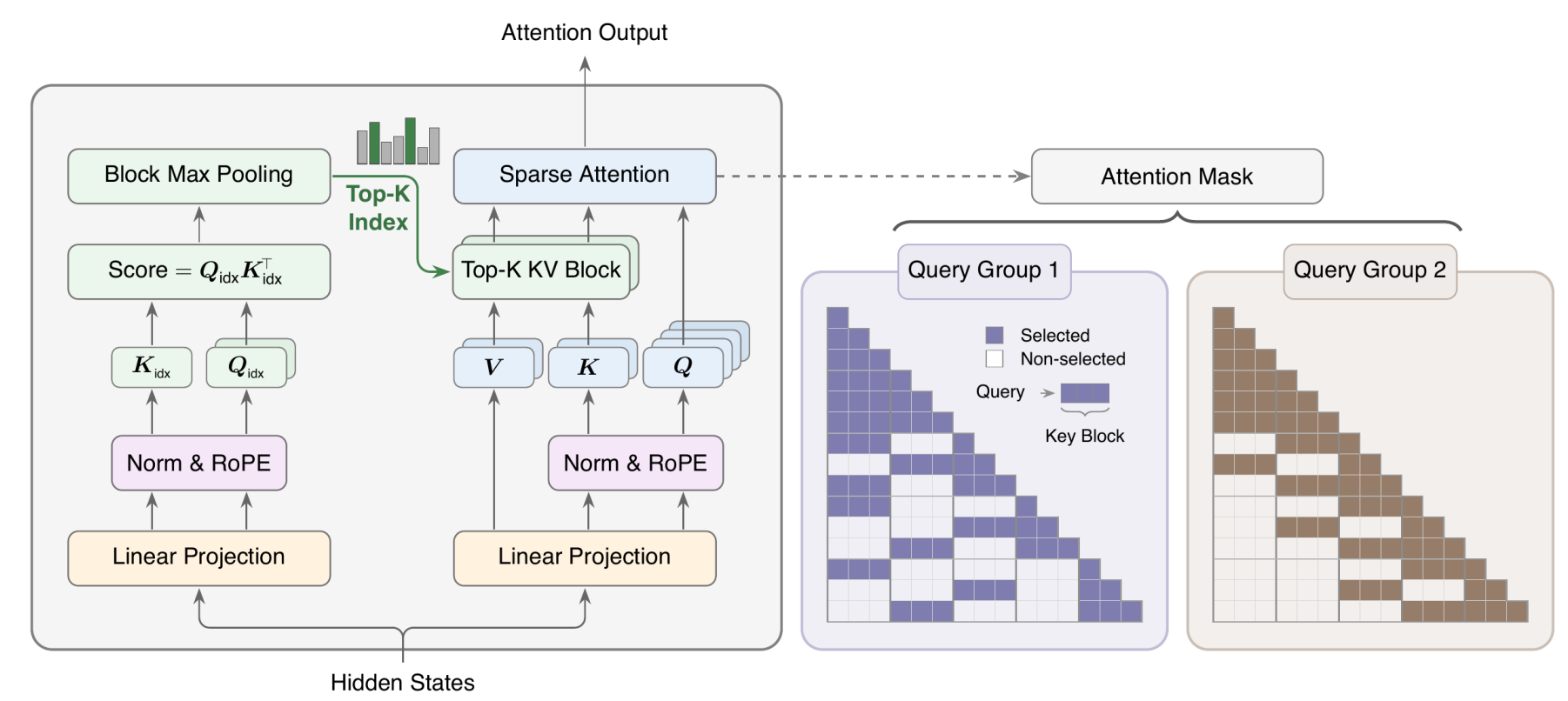
Ultra-long-context capability is becoming indispensable for frontier LLMs: agentic workflows, repository-scale code reasoning, and persistent memory all require the model to jointly attend over hundreds of thousands to millions of tokens, yet the quadratic cost of softmax attention makes this untenable at deployment scale. We introduce MiniMax Sparse Attention (MSA), a blockwise sparse attention built upon Grouped Query Attention (GQA). A lightweight Index Branch scores key-value blocks and independently selects a Top-k subset for each GQA group, enabling group-specific sparse retrieval while maintaining efficient block-level execution; the Main Branch then performs exact block-sparse attention over only the selected blocks. Designed around a principle of simplicity and scalability, MSA is deliberately streamlined, making it straightforward to deploy efficiently across a broad range of GPUs. To translate sparsity into practical speedups, we co-design MSA with a GPU execution path that uses exp-free Top-k selection and KV-outer sparse attention to improve tensor-core utilization under block-granular access. On a 109B-parameter model with native multimodal training, MSA performs on par with GQA while reducing per-token attention compute by 28.4x at 1M context. Paired with our co-designed kernel, MSA achieves 14.2x prefill and 7.6x decoding wall-clock speedups on H800.
Download
https://arxiv.org/abs/2606.13392
Code
https://github.com/MiniMax-AI/MSA
Cite
@article{lai2026msa,
  title={MiniMax Sparse Attention},
  author={Lai, Xunhao and Xu, Weiqi and Yang, Yufeng and Chen, Qiaorui and Xu, Yang and Zeng, Lunbin and Li, Xiaolong and Sun, Haohai and Zhu, Haichao and Zhang, Vito and Hu, Jinkai and Li, Jiayao and Gao, Rui and Li, Zekun and Zhu, Songquan and Zhou, Jingkai and Zhao, Pengyu},
  journal={arXiv preprint arXiv:2606.13392},
  year={2026}
}